“AI isn’t coming for your job—it’s coming for your whole org chart” (Fast Company, 7/20/2025). “Behind the curtain: A white-collar bloodbath” (Axios). “How does it feel to be replaced by a bot?” (The Guardian). “Which workers will AI hurt the most: the young or the experienced?” (New York Times). The AI boom has sparked new and widespread fears of mass unemployment, deskilling, and the “end of work.” Yet the history of automation is as long as the history of capitalism itself. And here in the Rust Belt it is impossible to ignore that deindustrialization and the resulting transformation of work have been underway at least since the 1970s. So what is actually new about the present? What does work look like today, across the capitalist world system? Is the “end of work” really just around the corner—and what would that even mean? How has work changed over the last fifty years and what might these changes tell us about the future? More generally, how has the character of work changed over the long history of capitalism?
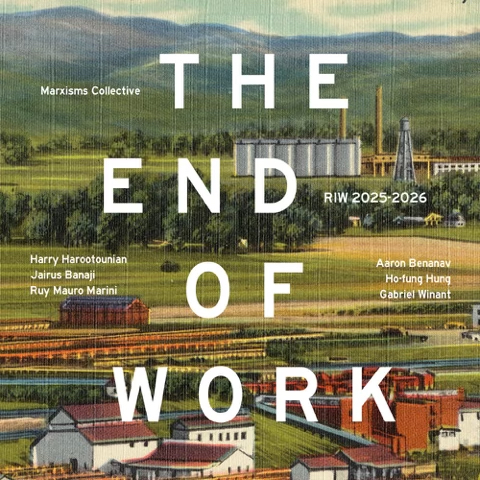
Building on our conversations during the 2024-2025 academic year under the theme of “crisis,” this year’s theme, The End of Work, aims to study the nature of work today. We will approach this question historically by reading the work of a series of thinkers and organizers representing a variety of disciplines and from both global North and South to better understand what work has looked like and how it has changed across the uneven structure of global capitalism over the last fifty years and beyond. Some of the theorists we intend to read include Ruy Mauro Marini (The Dialectic of Dependency), Jairus Banaji (Theory as History), Harry Harootunian (Marx after Marx), Aaron Benanav (Automation and the Future of Work), Gabriel Winant (The Next Shift), and Ho-fung Hung (TBD). We begin the year with Endnotes 4, “A History of Separation” which provides a historical perspective on the workers’ movement and considers the temporal and geographic contingencies of how we understand work. This sets us up to approach the question of labor through the lenses of subsumption, free labor, and super-exploitation as theorized by Harootounian, Banaji, and Marini, respectively. In the winter semester, we will turn to the work of Winant, Benanav, and Hung as we attend to some of the different contexts shaping the precarity of labor today. Throughout the course of the year, we engage with these historical perspectives in view of the need to rethink the concept of work.
If you would like to join the reading group please email sswartou at umich dot edu.
Shen Swartout, Felipe Moretti, Dan Nemser
 Marxisms collective at UMich