Financial crisis. Ecological crisis. Migration and refugee crises. A crisis of mental health. An opioid crisis in the hollowed-out Rust Belt. The crisis of democracy. A global pandemic, a persistent recession, escalating war, an ever-heating planet: crisis. The word hangs in the air, like dust, and it seems to be on everyone’s lips these days. One doesn’t need to look at the news to feel it, and few alive today would wager that we live in a stable world. Surely, the American-led capitalist system that has spread across the world and into all facets of our daily lives is falling apart before our eyes.
As much as people speak of “crisis,” the actual meaning of the word remains hazy. Is a crisis just when something goes wrong? Is it when the economy falters due to human error? Is a crisis an unpredictable deviation from the “normal”? Is it when things falter due to human error? Is a crisis an unpredictable deviation from the “normal”? Do all crises get resolved eventually? Are these accumulating emergencies, the so-called “polycrisis,” harbingers of the end of the world as we know it or just externalities of business as usual?
The Marxist tradition offers historical materialist frameworks for understanding why the dominant order appears to be so unstable in the present day. Despite their differences, Marxists generally agree that recurring crisis is internal to the workings of capitalism, which creates a potential opening for a radically alternative economic system to supersede it. As a result, crisis is fundamental to Marxism as a political project. Since the crisis of capitalism has permeated so many aspects of human existence, including the political, economic, ecological, and social, a comprehensive discussion of crisis is necessarily interdisciplinary and invites diverse academic perspectives.
This year’s workshop, Crisis at the End of the World, will take stock of the conceptual tools provided by Marx and thinkers in the Marxist tradition to understand the nature of crisis and its import for those living through it. Our task this semester will be two-fold. In the fall semester, we will theorize crisis itself, covering the history of the concept in the 20th century and its use by Marxist thinkers today. We will read Simon Clarke’s study Marx’s Theory of Crisis (1994), which offers a foundational approach to theories of crisis in Marx and the Marxist tradition; Robert Brenner’s influential article on the 2008 financial crisis, “What is Good for Goldman Sachs is Good for America: The Origins of the Current Crisis” (2009); and a series of articles from a recent special issue of South Atlantic Quarterly (April 2024) which explore crisis as a method for understanding world developments such as the rise of fascism.
In the winter semester, we will turn our attention to the various forms in which the present crisis expresses itself. We will read Nancy Fraser’s Cannibal Capitalism (2022), which discusses how capitalism sustains itself on unstable social reproductive contradictions, including racialization and the gendered labor of care; Joshua Clover’s Riot. Strike. Riot. (2016), which draws on Brenner’s concept of the long downturn to make sense of the upsurge in mass street protests that have erupted worldwide in recent years; and Andreas Malm’s White Skin, Black Fuel (2021), which explores the interconnected rise of far-right nationalist ideologies and climate change, rooted in capitalism’s dependence on fossil fuels. We will conclude our workshop with a screening and discussion of the recent film How to Blow Up a Pipeline (2022), an action thriller based on another book by Malm and grounded in the urgency of climate catastrophe and the fatal inaction of elite institutions to avert it.
If you would like to join the reading group please email fmoretti at umich dot edu and pchatha at umich dot edu.
Prayag Chatha, Felipe Moretti, Dan Nemser
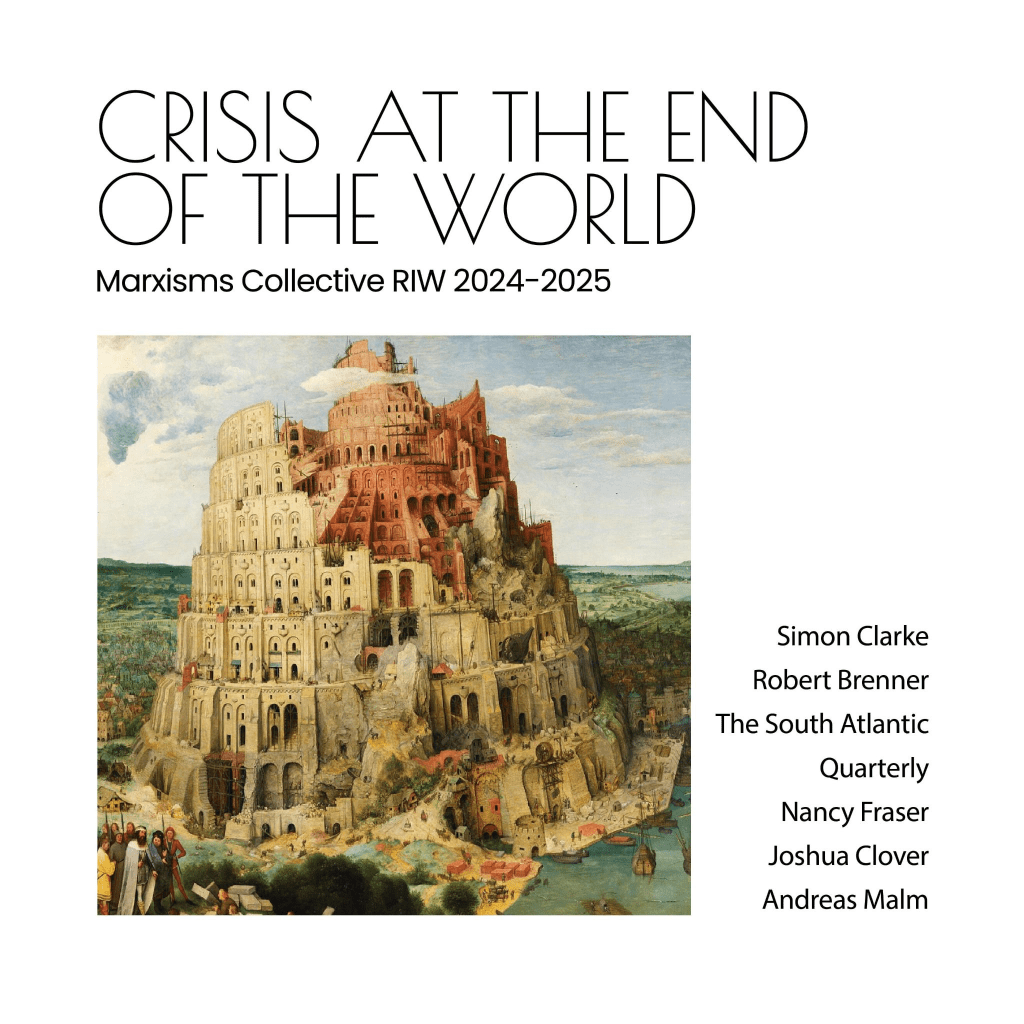
 Marxisms collective at UMich